
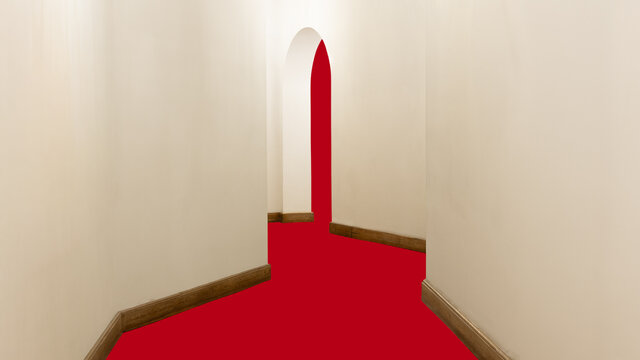
„Secret Chambers of Poland's Communist Regime”
2 October 2026 - 17 January 2027
The latest exhibition at the Royal Castle invites visitors into parts of the building previously off-limits to the public. On view are surviving architectural plans, photographs, furniture, and furnishings created during the reconstruction years for an official state residence that was never realized. This autumn, a forgotten chapter in the reconstruction of the Royal Castle in Warsaw will be told for the first time.
In 1974, when the Castle’s structure had already been rebuilt, the most challenging phase began: completing the historic interiors and creating a major permanent exhibition on the second floor. The Castle was intended to become a museum of Polish history and culture, open to thousands of visitors. At the same time, however, an idea emerged at the highest levels of power to create a prestigious apartment within the building for distinguished guests. Formal reception rooms, banquet halls, marble bathrooms, dressing rooms, kitchens, cold-storage rooms, elevators, and extensive service facilities were intended to serve the highest-ranking dignitaries visiting the Polish People’s Republic. Yet the building had been reconstructed in accordance with a functional program that designated it entirely for museum purposes, with only the Senate Hall intended for occasional receptions. Moreover, in Stanisław Lorentz’s plans, the Castle was to function as a branch of the National Museum in Warsaw, which meant there was no need for storage facilities, conservation studios, or extensive office space for staff - says Prof. Małgorzata Omilanowska, Director of the Royal Castle.
The idea of turning part of the Castle into guest accommodations conflicted with the vision of the circle around Professors Stanisław Lorentz, Jan Zachwatowicz, and Aleksander Gieysztor, who had spent years advocating for the Castle’s reconstruction. Different ideas clashed over how to use a place of such symbolic importance to Polish history and statehood: should it serve everyone, or only a select few?
Over six years, with enormous effort and at great expense, guest apartments with full ceremonial and technical facilities were created on the Castle's top floor. A separate elevator, reserved exclusively for official delegations, connected them with the ground floor. Extensive catering facilities were installed in the basement. As a result, nearly one-fifth of the rebuilt Castle’s floor space was allocated to the Office of the Council of Ministers. Paradoxically, this political decision created the conditions for one of the most interesting achievements in late-1970s Polish design. Architects Maria Referowska and Jan Maass designed the guest quarters. They did not create historicizing interiors or reconstructions of royal apartments. Instead, they designed a modern state residence intended to showcase the highest standards of Polish interior architecture and design. Their project encompassed everything - from the functional layout of the rooms to the smallest elements of the furnishings - says Dr. Jarosław Trybuś, Deputy Director for Museum Affairs.
Outside the Castle walls, however, a deepening economic and political crisis ultimately led the authorities to abandon the idea, and none of the anticipated high-profile guests ever crossed the threshold of these exclusive interiors. For the following decades, the space served as offices and museum support facilities, remaining inaccessible to the public.
In the current exhibition, we recreate part of a project abandoned many years ago. Spaces once intended as a luxury enclave for a privileged few have been arranged according to surviving plans and purchase records. Furniture, lamps, textiles, art glass, and decorative objects - scattered for years throughout the Castle’s storage rooms and offices - have been returned to the context for which they were originally selected. Secret Chambers of Poland's Communist Regime is a story not only about the political ambitions of the final years of the Edward Gierek era, but also about Polish design.
The exhibition also features photographs by Chris Niedenthal, one of Europe’s most distinguished photojournalists, who documented everyday life in Poland in the late 1970s and early 1980s. His photographs show the Castle during its reconstruction - still unfinished and filled with people absorbed in their work. Most of these images have never been published before.
A variety of accompanying events and an extensive educational program have been prepared in connection with the exhibition. The exhibition is accompanied by a publication featuring essays by Małgorzata Omilanowska, Błażej Brzostek, Anna Cymer, Piotr Korduba, Artur Tanikowski, Anna Kostrzyńska-Miłosz, Katarzyna Uchowicz, Marcin Napiórkowski, and Mikołaj Baliszewski.
Due to the nature of the historic interiors in which the exhibition is presented, the space is unfortunately not accessible to visitors with limited mobility. A virtual tour with the curators is currently being prepared.
Exhibition Curators: Dr. Mikołaj Baliszewski, Zuzanna Potocka-Szawerdo


