
The Royal Clockmakers’ Room
Permanent exhibition of historical clocks
The Royal Castle in Warsaw
Beginning October 21, 2026, visitors to the Royal Castle in Warsaw will be able to explore a new permanent exhibition, The Royal Clockmakers’ Room. The exhibition will feature an exceptional collection of historic clocks and tell the stories of the clockmakers - masters of precision and craftsmanship who were associated with the Castle and the royal court over the centuries. The historic objects will be presented in a contemporary setting designed by Katarzyna Krakowiak-Bałka. The room heralds a new presentation of the Castle's historic decorative arts collections through contemporary artistic interpretations.
One of the starting points for this story is the clock on the Castle's Clock Tower, which had been in operation since 1622 and was part of Warsaw's network of public timepieces. In 1816, following repairs and modifications to its mechanism carried out by Franciszek Gugenmus, the clock was designated the official reference for timekeeping in Warsaw. Its time was used to set clocks on church towers and those displayed in the windows of Warsaw's clockmakers' shops. In 1845, the more accurate clock at the Town Hall on Teatralny Square took over as the city's official timekeeping reference.
Behind these mechanisms were the people who kept them running. Winding the tower clock, which involved raising its weights every three days, and maintaining the Castle's other timepieces required the constant presence of a clockmaker. Over the centuries, the royal residence was associated with some of the most distinguished clockmakers of their time, including Salomon Krigner, Karl Christoph Krüger, Daniel Schepcke, Franciszek Gugenmus and his son Antoni, and later members of the Lilpop family. Combining technical expertise, precision, and exceptional craftsmanship, they created timepieces for monarchs and the royal court.
The exhibition will showcase historic timepieces, including horizontal table clocks, carriage clocks, and pocket watches. Among them are works by clockmakers associated with the Polish royal court, as well as outstanding examples of European clockmaking. Originating from various centers, including Warsaw, Vilnius, Kraków, Lublin, Lviv, Gdańsk, Toruń, Königsberg, Wrocław, Dresden, Paris, and London, as well as Switzerland, these timepieces offer insight into how knowledge, technical innovations, and artistic styles circulated among clockmaking workshops.
A special place in the exhibition is reserved for horizontal table clocks (or “tile clocks”), which were a specialty of clockmakers working in the Polish-Lithuanian Commonwealth during the 17th and 18th centuries. Today, they are admired for their elaborate decoration, but in their time, they were also technologically advanced devices. Accurate and resistant to shocks, they could accompany their owners on their travels. The technical innovations incorporated into these clocks marked an important step in the development of carriage clocks, pocket watches, and eventually wristwatches.
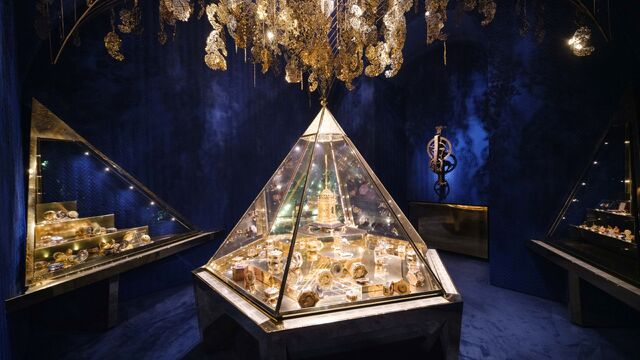
Their uniqueness extends far beyond their cases. No two clocks are identical - each is the result of collaboration among numerous specialists: clockmakers, metal casters, engravers, chasers, locksmiths, and goldsmiths. Even components concealed within the mechanisms were intricately decorated. On 17th-century covers and balance cocks - elements protecting the heart of the clock - delicate scrollwork featured leaves, flowers, and wild strawberries. This ornamental motif has been incorporated into the contemporary design of the Royal Clockmakers’ Room.
The exhibition design was created by Katarzyna Krakowiak-Bałka, with Konrad Nawrocki serving as curator of the collection. The artist drew inspiration from the wild strawberry motif found in the decoration of 17th-century clock mechanisms. The motif of delicate sprigs has been repeated as many as 500 times. The display case housing the clock collection and the installation suspended above it together form an hourglass, one of the oldest devices used to measure time. The hexagonal design, meanwhile, echoes the shape of most of the table clocks on display. The installation is complemented by a soundscape consisting of twelve short compositions based on recordings of the clocks featured in the exhibition. The visual elements of the design are also the work of skilled craftspeople: the soft fabrics surrounding the space were pleated in a small workshop in France, while the metal components were polished by hand.
“The Royal Clockmakers’ Room offers a preview of a new exhibition showcasing the Castle’s decorative arts collections through contemporary artistic interpretations. For the subsequent sections of the exhibition, the Castle has invited artists to develop concepts for presenting its major collections in close collaboration with the curatorial team,” says Dr. Jarosław Trybuś, Deputy Director for Museum and Program Affairs.
The clocks on display belong to the Royal Castle in Warsaw, the Ciechanowiecki Collection Foundation, and the Teresa Sahakian Foundation.
The Royal Clockmakers’ Room will be open to the public from October 21, 2026.
Project supervisor: dr Jarosław Trybuś
Curator of the clock collection: Konrad Nawrocki
Artist, exhibition designer: Katarzyna Krakowiak-Bałka
Architect, designer of the detailed plans: Zofia Stachura


